
FAQ About Purchasing Tungsten Plate
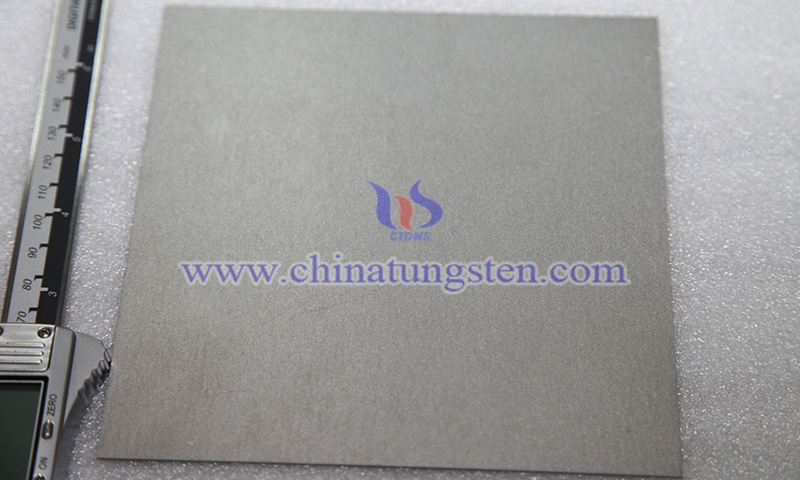
The following FAQ on tungsten plate has been compiled by CTIA GROUP based on nearly 30 years of experience serving customers. It summarizes the most common questions and practical guidance to help you understand our products, specifications, processing, and purchasing process.
1. Commonly Supplied Tungsten Plate Specifications
CTIA GROUP can routinely supply tungsten plates with the following specifications:
Thickness: 0.1mm–50mm
Width: ≤600mm
Length: ≤1000mm
These specifications cover most industrial applications, from thin to thick plates. Tungsten plates are generally produced from powder metallurgy sintered billets through multiple hot rolling and machining processes. Different thicknesses require adjustments in rolling and stress control. In addition to standard sizes, CTIA GROUP can provide custom production based on customer drawings, offering cutting, grinding, and precision machining to meet the needs of structural components, thermal field parts, and high-temperature assemblies.
2. Do You Support Customized Tungsten Plate Processing?
Yes. CTIA GROUP supports non-standard sizes and special tolerance machining, customized according to customer drawings or technical requirements.
Different equipment structures have varying requirements for dimensional tolerance, flatness, surface roughness, and edge precision. Using CNC machining, precision grinding, and wire cutting, we can produce non-standard components while controlling processing stress and material stability to ensure structural reliability and long-term performance in high-temperature environments.
3. What Factors Affect Tungsten Plate Pricing?
Pricing is mainly influenced by raw material cost fluctuations, purity grade, size specifications, processing difficulty, and order quantity. Tungsten is a strategic refractory metal, and tungsten powder prices are affected by global supply and market demand. Purity, sintering density, dimensions, and required machining all impact manufacturing cost. High-precision or complex parts incur additional processing and inspection costs. Providing complete technical parameters or drawings when requesting a quote ensures accurate evaluation. Bulk orders or long-term projects often receive more stable pricing.
4. Do You Support Small-Quantity Orders?
Yes. Standard specifications can be supplied in small quantities. For research, equipment development, or prototype testing, small batches are often required. Custom sizes or heavily processed products may require minimum order quantities based on the complete production workflow, including sintering, rolling, and machining, to ensure production stability and material consistency.
5. What Is the Delivery Time?
Stock items: 7–15 days
Customized items: 20–35 days, depending on production schedule and processing complexity
Tungsten plate production involves powder metallurgy sintering, hot rolling, stress relief, and precision machining. Stock items can be delivered quickly, while custom items depend on material size, machining precision, and inspection requirements. Large plates or high-precision components may require extended lead times.
6. Do You Provide Inspection Reports?
Yes. CTIA GROUP can provide chemical composition reports, density data, and dimensional inspection records. Material quality is controlled through spectroscopy or chemical analysis for impurity content and density measurements for sintering quality. Dimensional and visual inspection reports can also be provided. For high-end projects, third-party verification is available to ensure data objectivity and traceability.
7. What Is the Standard Purity of Tungsten Plate?
Standard tungsten plates are W≥99.95%. High-purity tungsten is produced from high-purity tungsten powder via powder metallurgy, with strict control of impurities during sintering and rolling to ensure high-temperature stability and thermal/electrical conductivity. Higher-purity materials are available for semiconductor equipment, high-temperature vacuum environments, or specialized research applications.
8. What Is the Density of Tungsten Plate?
The theoretical density of tungsten is 19.3 g/cm3. CTIA GROUP typically produces plates with a density of 19.1–19.2 g/cm3, close to theoretical values. Higher density indicates lower porosity and more uniform microstructure, improving strength, thermal conductivity, and high-temperature stability.
9. What Standards Do Tungsten Plates Follow?
Common reference standards include ASTM B760 and GB/T 3875, covering chemical composition, dimensional tolerances, surface quality, and physical properties. Production is generally based on international or national standards, and can also follow customer technical agreements, corporate standards, or equipment requirements.
10. What Processing Can Be Done on Tungsten Plate?
CTIA GROUP offers wire cutting, precision grinding, drilling, and CNC machining. Tungsten’s high hardness and brittleness require proper tool selection, cutting parameters, and stress control to avoid microcracks or edge chipping. Wire cutting is commonly used for complex profiles, while grinding achieves high dimensional accuracy and surface quality.
11. Can Tungsten Plates Be Welded?
Pure tungsten is difficult to weld and generally requires electron beam or vacuum welding. Due to its high melting point and brittleness, conventional welding is challenging. For high-temperature structural components, CTIA GROUP recommends machining components from a single piece to minimize weld-related failure risks.
12. Will Tungsten Oxidize at High Temperatures?
Tungsten is chemically stable at room temperature. Above ~400°C in air, it gradually forms tungsten oxide on the surface. Oxidation accelerates with higher temperatures. For high-temperature applications, tungsten should be used in vacuum or inert gas environments (e.g., argon or hydrogen) to reduce oxidation and extend service life.
13. Is Tungsten Plate Prone to Deformation?
Under prolonged high-temperature and continuous stress, tungsten plates may experience some thermal stress deformation. Deformation depends on thickness, support structure, and temperature distribution. Design measures such as thicker plates, additional supports, or optimized heating uniformity, along with stress-relief treatments during production, can improve dimensional stability.
14. How to Evaluate Tungsten Plate Quality?
Quality evaluation requires multiple factors: verifying purity, measuring density to assess sintering quality, inspecting surfaces for cracks or defects, and checking uniformity of microstructure. Consistent production processes, comprehensive quality inspection, and complete inspection reports ensure reliable tungsten plate quality.
For any inquiry, please contact?tungsten plate manufacturer: CTIA GROUP
Email: sales@chinatungsten.com
Tel: 0086 592 5129696 / 0086 592 5129595
Website: www.baixiaosheng123.com
WeChat:

More info>>