
Common Questions and Answers About Tungsten Heaters
1. Basic Questions About Tungsten Heaters
Q1: What’s Tungsten Heater?
A: Tungsten heater is essentially a type of high-temperature resistance heating element that uses metallic tungsten as the conductive and heating core. Its base material is typically pure tungsten wire or doped tungsten wire, such as potassium-doped tungsten or rare earth doped tungsten. Through wire drawing, twisting, winding, or forming processes, the material is fabricated into heating components with specific geometric structures.
Long-term practical applications have shown that tungsten heater is not a standardized component, but rather a highly customized thermal field execution unit. Its core structure generally consists of three parts: (1) Conductive heating element (tungsten wire body); (2) Structural configuration (coil, basket, U-frame, etc.); (3) Electrothermal parameter design (resistance and power distribution).
Within CTIA GROUP’s design system, tungsten heater is usually integrated as part of an equipment thermal field system and requires coordinated design with the power supply, vacuum system, and workpiece positioning, rather than functioning as an independent standalone product.
Q2: How Does Tungsten Heater Work?
A: The operating mechanism of tungsten heater can be divided into two aspects: electrical process and thermal process.
(1) Electrical Process: When electric current passes through tungsten wire, Joule heat is generated due to the electrical resistance of tungsten. The fundamental relationship is expressed as P = I2R or P = U2/R.
(2) Thermal Process: The generated heat is mainly transferred through the following three methods: thermal radiation (dominant, especially in high-temperature vacuum environments), thermal conduction (through support structures), and thermal convection (only present in atmospheric environments). At temperatures above 1800°C, thermal radiation becomes the dominant heat transfer mechanism. Its energy release follows the Stefan-Boltzmann law, where radiative power is proportional to the fourth power of temperature.
CTIA GROUP achieves temperature uniformity in practical designs by adjusting the following parameters: (1) Wire diameter and length distribution; (2) Localized resistance design; (3) Structural spacing and radiation angle. These measures essentially control thermal field distribution through resistance distribution optimization.
Q3: Why Is Tungsten Used as Material for Heaters?
A: Tungsten becomes a high-temperature heating material because of its unique combination of extreme material properties. Key physical parameters of tungsten heating materials are as follows:
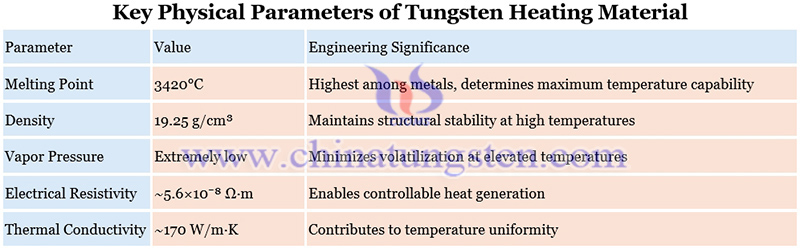
A more critical factor is that tungsten can still maintain metallic strength above 2000°C, while most metals have already melted or significantly softened at such temperatures. CTIA GROUP further differentiates material systems based on application requirements, including cost-effective pure tungsten, potassium-doped tungsten with improved anti-sag performance, and rare earth doped tungsten with superior high-temperature stability.
Q4: What’s the Maximum Operating Temperature of Tungsten Heater?
A: From the material limit perspective, tungsten heater can theoretically operate close to 3000°C, but practical engineering applications do not typically use it under such extreme conditions. Tungsten heater operating temperature and applications are as follows:

The key factors limiting maximum operating temperature are not melting point itself, but recrystallization-induced strength reduction, creep deformation (sagging), evaporation loss, and surface contamination. Tungsten heater should not be designed solely based on maximum temperature limits. CTIA GROUP believes that the optimal solution should balance service life and operational stability.
Q5: Can Tungsten Heaters Be Used in Air?
A: No. This is one of the most critical limitations of tungsten heater applications. At elevated temperatures, tungsten reacts with oxygen to form tungsten trioxide (WO?), which features strong volatility and easy sublimation, resulting in rapid material consumption.
The oxidation behavior of tungsten generally follows these stages:
(1) <300°C: Basically stable;
(2) 400–600°C: Oxidation begins;
(3) >800°C: Rapid oxidation and failure.
Therefore, CTIA GROUP typically requires the following operating environments for tungsten heaters:
(1) Vacuum environment (preferred);
(2) Hydrogen reducing atmosphere;
(3) Inert gas atmosphere (Ar, N?).
Any oxygen-containing environment will drastically reduce the service life of tungsten heater.
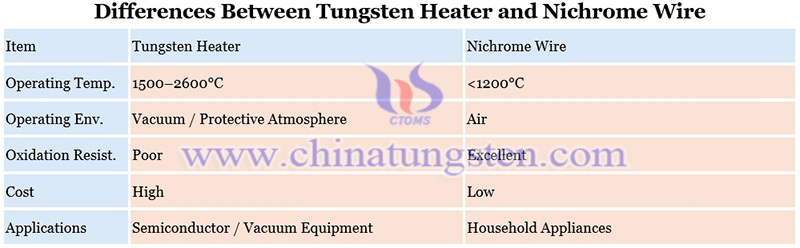
Q6: What Are Differences Between Tungsten Heaters and Nichrome Wires?
A: The essential difference lies in the material system and operating environment. These two products are not substitutes, but belong to completely different application systems. Differences between tungsten heater and nichrome wire are as follows:
Q7: What Are Differences Between Tungsten Heaters and Molybdenum Heaters?
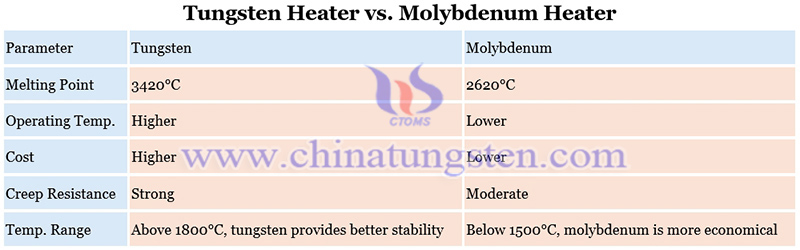
A: Molybdenum and tungsten are both refractory metals, but their performance differences define their application boundaries. CTIA GROUP usually recommends materials according to operating temperature ranges.Tungsten heater vs molybdenum heater:
Q8: What Type of Heating Method Does Tungsten Heater Belong To?
A: From the perspective of physical mechanism, tungsten heater is a resistance heating element, but its engineering performance is closer to a radiant heating system. When the temperature exceeds 1500°C, thermal radiation accounts for more than 80% of heat transfer, while convection becomes almost negligible in vacuum environments. Design priorities therefore focus on radiation area, radiation direction, and thermal field uniformity. CTIA GROUP consistently follows the principle of developing cost-effective high-temperature radiation sources for customers.
Q9: What Are Basic Structures of Tungsten Heaters?
Q10: Why Are Tungsten Heaters Widely Used in High-End Equipment?
2. Requirements and Applications of Tungsten Heaters
Q11: What’s Operating Temperature of Tungsten Heater?
Q12: What’s Operating Environment of Tungsten Heater?
Q13: What Are Heating Targets of Tungsten Heaters?
Q14: Are Tungsten Heaters Used Continuously or Intermittently?
Q15: What’s Installation Space Requirement for Tungsten Heaters?
3. Common Questions About Tungsten Heater Specifications and Selection
Q16: How Are Tungsten Heater Specifications Expressed?
Q17: How to Select Tungsten Heater Wire Diameter?
Q18: How to Determine Tungsten Heater Strand Number?
Q19: How to Select Tungsten Heater Shape?
Q20: How to Design Tungsten Heater Dimensions?
Q21: How to Calculate Tungsten Heater Resistance?
Q22: How to Match Current and Voltage for Tungsten Heaters?
Q23: Are Tungsten Heaters Customizable?
Q24: How to Match Tungsten Heaters to Different Temperature Ranges?
Q25: How Do Tungsten Heaters Achieve Uniform Heating?
4. Material and Performance of Tungsten Heaters
Q26: Should Pure or Doped Tungsten Wire Be Used for Heaters?
Q27: What Are Advantages of Doped Tungsten Wire in Tungsten Heaters?
Q28: What’s Recrystallization Temperature of Tungsten Heaters?
Q29: How to Evaluate Anti-Sag Performance of Tungsten Heaters?
Q30: What Factors Affect Service Life of Tungsten Heaters?
5. Applications of Tungsten Heaters
Q31: What Industries Use Tungsten Heaters?
Q32: What’s Role of Tungsten Heaters in Coating Processes?
Q33: What Are Applications of Tungsten Heaters in Photovoltaic Industry?
Q34: What’s Role of Tungsten Heaters in Semiconductor Industry?
Q35: Are Tungsten Heaters Suitable for Laboratory Use?
Q36: Can Tungsten Heaters Replace Conventional Furnace Heating Elements?
Q37: What Atmospheres Are Suitable for Tungsten Heaters?
Q38: What’s Role of Tungsten Heaters in Electron Beam Evaporation?
Q39: What’s Relationship Between Tungsten Baskets and Tungsten Heaters?
Q40: Are Tungsten Heaters Suitable for Continuous or Intermittent Operation?
6. Manufacturing and Quality of Tungsten Heaters
Q41: How Are Tungsten Heaters Manufactured?
Q42: How to Control Tungsten Heater Quality?
Q43: Do Tungsten Heaters Require Surface Treatment?
Q44: Are There Standards for Tungsten Heaters?
Q45: How to Prevent Tungsten Heater Fracture?
7. Usage and Maintenance of Tungsten Heaters
Q46: How to Install Tungsten Heaters?
Q47: Can Tungsten Heaters Be Bent?
Q48: How to Extend Service Life of Tungsten Heater?
Q49: Why Do Tungsten Heaters Burn Out?
Q50: How to Handle Tungsten Heater Issues?
Q51: Does CTIA GROUP Recycle Used Tungsten Heaters?
Read More: Common Questions and Answers About Tungsten Heaters.pdf
For any inquiry, please contact?tungsten heater manufacturer: CTIA GROUP
Email: sales@chinatungsten.com
Tel: 0086 592 5129696 / 0086 592 5129595
Website: www.baixiaosheng123.com
WeChat:

More info>>
1.Tungsten heater quotation table
2. Catalog of tungsten heater
3. Tungsten heater models
4. Stranded tungsten wire for making tungsten heater